 ®Design your facility
OPERATOR GUIDE
Choose the operating outcome before you choose the enclosure.
A grow box is not one universal product. The right starting point depends on what the operation needs to produce, where it needs to operate and how soon capacity may need to change. A good first decision creates a useful working environment. A rushed one can leave an operator with the wrong footprint, limited workflow or an expensive expansion problem.
This guide is designed for licensed operators and project teams comparing practical paths into controlled-environment cultivation. It does not rank one box as universally best. It helps you identify the system that fits the job in front of you.
Begin with five project facts
Before comparing equipment lists, document the facts that shape the room. They make supplier conversations more useful and make it easier to spot an option that only looks simple on paper.
- Production target: Define the crop, cultivation method, target canopy and harvest rhythm the first phase must support.
- Site conditions: Confirm access, available power, water, drainage, placement area and the local approvals that affect the project.
- Room programme: Decide which functions must happen now, such as propagation, flowering, drying, curing, storage or staff workflow.
- Operating team: Account for how people, plants, supplies and waste move through the space, not only where the equipment fits.
- Next phase: Identify the first likely constraint so the initial project does not block the expansion it is meant to enable.
The best first purchase is the one that supports the actual operating plan, not the one with the longest feature list.
Match the system to the deployment
For a stand-alone, transportable cultivation environment, a container grow room can provide a defined footprint with the core growing infrastructure integrated before delivery. This path can suit a first production room, a temporary capacity need or a site where a compact self-contained system is the most practical starting point.
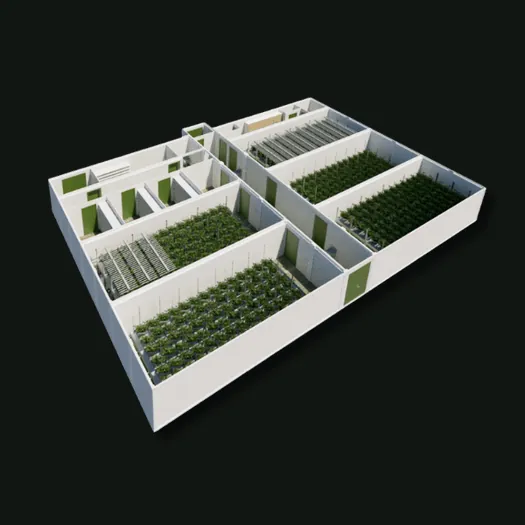
For an operation using an existing building, planning multiple connected rooms or preparing for a larger buildout, a modular panel system offers a different kind of flexibility. Room dimensions, circulation, crop stages and service access can be arranged around the facility workflow. That does require a clearer site and operating plan, but it can be the stronger choice when the goal is a connected facility rather than a single room.
Compare the decisions that affect the operation
- Environmental control: Ask how temperature, humidity, airflow, lighting and irrigation are designed around the crop and room load, then establish who will commission and maintain each system.
- Workflow and sanitation: Map the movement of plants, staff, tools and harvested material. A room that is easy to enter but difficult to clean, service or move through becomes an operating cost.
- Utility readiness: Confirm the site can support the load. Electrical service, water, drainage, ventilation paths and equipment access should be resolved before delivery or installation dates are set.
- Service access: Equipment needs to be reachable when the crop is in the room. Reserve the clearances required for routine maintenance rather than treating them as leftover space.
- Expansion logic: Decide whether the next constraint is flowering canopy, propagation, drying capacity, storage or circulation. The first phase should leave a practical path to solve that constraint.
Know what a supplier should help you clarify
A credible early conversation should move beyond a list of included equipment. The supplier should be able to discuss the intended crop workflow, site access, utilities, room sequence, operating constraints and the point at which capacity needs to grow. Final engineering, permitting and code decisions belong with the appropriate qualified professionals for the project location, but those considerations should be surfaced early.
Box4Grow® plans container rooms and modular panel systems around those practical inputs. The aim is not to force every operator into the same enclosure. It is to turn the operating plan into a facility path that can be deployed, run and expanded with more confidence.
Questions operators ask before choosing a grow box
What should a first-time commercial grow-box buyer decide first?
Start with the crop, the target canopy, where the system will sit, the utilities available on site and who will operate it. Those choices determine whether a container room, a modular panel system or a phased combination is the practical fit.
Is a container grow room the same as a modular panel system?
No. A container grow room is a self-contained, transportable room suited to stand-alone deployment. A modular panel system creates configurable connected rooms inside an existing building or as part of a larger facility buildout.
Can a grow-box project expand later?
It can, when the first phase is planned around the next constraint. That may mean protecting access, utilities, workflow and room sequencing so the next room or larger panel-system phase can be added without undoing the first investment.